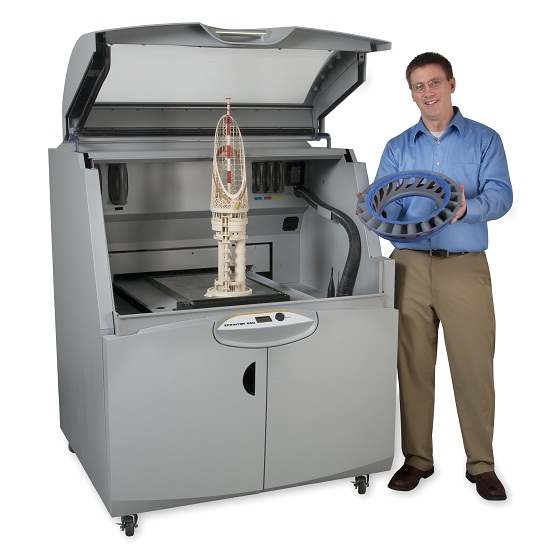
3-D printing is a process of making a three-dimensional solid object of virtually any shape from a digital model. 3D printing is achieved using an additive process, where successive layers of material are laid down in different shapes. 3D printing is considered distinct from traditional machining techniques, which mostly rely on the removal of material by methods such as cutting or drilling.A materials printer usually performs 3D printing processes using digital technology. Since the start of the twenty-first century there has been a large growth in the sales of these machines, and their price has dropped substantially.

The technology is used for both prototyping and distributed manufacturing in jewelry, footwear, industrial design, architecture, engineering and construction , automotive, aerospace, dental and medical industries, education, geographic information systems, civil engineering, and many other fields.Future applications for 3D printing might include creating open-source scientific equipment or other science-based applications like reconstructing fossils in paleontology, replicating ancient and priceless artifacts in archaeology, reconstructing bones and body parts in forensic pathology, and reconstructing heavily damaged evidence acquired from crime scene investigations. The technology is even being explored for building construction.

In 2005, academic journals had begun to report on the possible artistic applications of 3D printing technology.By 2007 the mass media followed with an article in the Wall Street Journal and Time Magazine, listing a 3D printed design among their 100 most influential designs of the year. During the 2011 London Design Festival, an installation, curated by Murray Moss and focused on 3D Printing, was held in the Victoria and Albert Museum (the V&A). The installation was called Industrial Revolution 2.0: How the Material World will Newly Materialise.As of 2012, 3D printing technology has been studied by biotechnology firms and academia for possible use in tissue engineering applications in which organs and body parts are built using inkjet techniques. In this process, layers of living cells are deposited onto a gel medium or sugar matrix and slowly built up to form three-dimensional structures including vascular systems.Several terms have been used to refer to this field of research: organ printing, bio-printing, body part printing,and computer-aided tissue engineering, among others.3D printing can produce a personalized hip replacement in one pass, with the ball permanently inside the socket and is available in printing resolutions that don't require polishing.

The use of 3D scanning technologies allows the replication of real objects without the use of moulding techniques that in many cases can be more expensive, more difficult, or too invasive to be performed, particularly for precious or delicate cultural heritage artifacts where direct contact with the molding substances could harm the original object's surface. Objects as ubiquitous as smartphones can be used as 3D scanners: Sculpteo unveiled a mobile app at the 2012 Consumer Electronics Show that allows a 3D file to be generated directly via smartphone.

Here is another wonder of science watch the red hot ice.......

ITS ALL BY 'INDUCTION' NO MAGIC.......


1. The word “book”
Liber is the Latin word for book, which comes from the Romans, who used the thin layer found between the bark and the wood (the liber) before parchment came along. The English word for book is derived from the Danish word “bog,” which means birch tree. That makes sense because early writers in Denmark wrote on birch bark.

2. How much is that book?
If you think today’s book prices are retarded, consider this: An original copy of Chaucer's Canterbury Tales sold for a record 7.4 million (in US dollars) at Christies in London in 1998. The book was printed in 1477 though, so unless you plan on living another 500 or so years, you’re not likely to see a royalty from that kind of sale.

3. Diving Through the Looking Glass and Into the Pocketbook
Children’s fiction seems to age well. A rare first edition of Alice's Adventures in Wonderland sold for 1.5 million at auction in New York. This makes it the most valuable children's book ever sold. It was Carroll's own working copy, so that probably contributed to the inflated price. There are only 22 copies of the 1865 first edition known to exist today, and only five made it to some private owner’s hot little hands. So we know that there are at least five people in the world with more money than brains.

4. When digital looks real good.
The Buddhist Bible was originally engraved on 729 white marble tablets. These tablets are regarded by Myanmar Buddhists as orthodox texts. The tablets are kept in a square, each protected by its own temple. Each marble tablet is about 3 inches wide and 4 inches long. Try to carry that around in your bag.

5. Bigass Library
The Library of Congress (Washington DC) contains 28 million books and has more than 500 miles of shelving. It would take you eight hours to pass every single book, if you were driving in a car at 70 mph. I’d hate to be the one in charge of dusting.

6. Everyone loves a good mystery.
Who’s the bestselling commercial fiction author of all time? Not Meyer. Not Rowling. Not even King. No, the bestselling author of all time is Agatha Christie. Since 1920 her books have sold over a billion copies in the English language, and another billion in more than 45 other languages. She is outsold only by the Bible and William Shakespeare.

7. But are they good?
We like to toss around the term “prolific” when a writer publishes more than say, two books a year. Honey, you don’t know prolific. Between 1986 and 1996, Brazilian author Jose Carlos Ryoki de Alpoim Inoue published 1,058 novels in the western, science fiction and thriller genres. But are they any good?

8. Poe is creepier than you think.
Edgar Allan Poe wrote about death and all other things dark and macabre. His life itself is a pretty dark story. But his themes and his life are not the most creepy details about Mr. Poe. He wrote a short story in 1838, titled "The Narrative of Arthur Gordon Pym of Nantucket." In the story, three shipwreck survivors in an open boat kill and eat the fourth man, named Richard Parker. In 1884, (almost 50 years LATER) three real-life shipwreck survivors in an open boat killed and ate the fourth man, whose name was also Richard Parker..

9. Stop bitching about royalties.
You think it’s tough to make ends meet as a writer today? Consider that William Shakespeare's average annual income as a playwright was under 32 dollars (USD), which works out to about 13 dollars per play. He made about twice as much from writing plays as Ben Jonson.

10. And also, about Shakespeare
Shakespeare makes Lear, whose character was an early Anglo-Saxon King, mention spectacles. In Macbeth, who dies in 1054, and when writing of King John's reign in 1200, Shakespeare mentions cannons. In Julius Caesar, he has a clock striking three. What’s wrong with these things? Spectacles, cannons and clocks were not invented until the fourteenth century, long after the times in which he set these tales.
Highest Team Total in an inning in IPL: In the 32nd game of IPL 2010, Chennai Super King broke its own record and posted the highest score in the history of IPL, which is still the best. On April 3 at MA Chidambaram Stadium in Chennai, the host team scored 246 runs for the loss of five wickets against Rajasthan Royals. CSK opener Murali Vijay scored 127 runs in just 56 balls with 8 fours and 11 sixes. Albie Morkel played an inning of 62 runs in 34 balls. Out of CSK’s 246 runs, 178 runs came from boundaries. Chennai Super Kings, the winner of the IPL 2010, won that match by 23 runs. Chennai Super King’s earlier best was 240 against Punjab in Mohali in IPL 2008.

Lowest Team Total in an inning in IPL: In the second game of the IPL 2009, played at Newlands, Cape Town in South Africa, the defending champion Rajasthan Royals scored only 58 runs, which is the lowest ever team total in an inning in IPL. Rajasthan Royals was chasing the target of 134 against Royal Challengers Bangalore and the whole team were all out for 58 runs in 15.1 overs. Only three Rajasthan Royals batsmen scored in double figures and three left the crease without any score. Best partnership for the Rajasthan Royals was of 19 runs between Yusuf Pathan and Ravindra Jadeja. Second lowest team total in IPL is 67, scored by Kolkata Knight Riders against Mumbai Indians in 2008.


Highest run getters in IPL matches: Chennai Super King’s batsman Suresh Raina is the leading run getter in the IPL. In the 62 inning of all the four IPL seasons, Suresh Raina has scored 1813 runs with an average of 35. His highest individual score is 98 runs. After Suresh Raina, Mumbai Indians’ captain Sachin Tendulkar is the highest run getter in the IPL. He scored 1723 runs in 51 innings of the tournament with an average of 40. He came up with his maiden century against the Kochi Tuskers Kerala in the IPL 2011. Former Deccan Chargers captain and now Kings XI Punjab captain Adam Gilchrist is the third leading run getters in the IPL. In 60 IPL innings, Gilchrist scored 1603 runs with an average of 27. He is the only batsmen in IPL who has scored more than one hundred.

Maximum wicket takers in IPL matches: RP Singh, who played IPL for two different teams- Deccan Chargers and Kochi Tuskers Kerala, and in IPL 2012, will play for Mumbai Indians, is the highest wicket taker in all IPL matches. In his 56 IPL matches, RP Singh has claimed 64 wickets. In the 2009 edition of the IPL, where his team Deccan Chargers lifted the trophy in South Africa, claimed 23 wickets. After RP Singh, his IPL 2012 teammate Mumbai Indians’ Lasith Malinga is second in the list of leading wicket taker. His tally is 62 wickets in just 42 matches. Amit Mishra, who is now playing for Deccan Chargers and earlier played for Delhi Daredevils, has also picked 62 wickets from 45 matches.

Maximum individual runs in an inning in IPL: In the inaugural game of IPL on April 18, 2008 at M Chinnaswamy Stadium in Bangalore, Kolkata Knight Riders' opener Brendon McCullum scored unbeaten 158 runs in 73 balls against Royal Challengers Bangalore. He reached the 100 runs mark in 53 balls. In his inning, Brendon McCullum got 118 runs through fours and sixes. Murali Vijay, who scored in 56 balls 127 runs against Rajasthan Royals at MA Chidambaram Stadium in Chennai on April 3, 2010, is the second highest individual run in an inning in the IPL. In his inning, Murali Vijay scored 98 runs through boundaries. Paul Valthaty of Kings XI Punjab, who scored unbeaten 120 runs against CSK at Mohali, is the third highest individual run in an inning in IPL.

Best bowling figure in an inning in IPL: In the first edition of IPL in 2008, on May 4 at Sawai Mansingh Stadium in Jaipur, Rajasthan Royals’ left-arm medium pacer Sohail Tanvir claimed six wickets of Chennai Super Kings just for 14 runs, is the still ever best bowling figure in an inning in IPL. He claimed the wickets of the openers at zero runs in the first over of the game. In the second edition of the IPL, Anil Kumble of Royal Challengers Bangalore picked five wickets for Rajasthan Royals for just five runs in 3.1 overs in Cape Town. Due to his magic figures, Rajasthan Royals scored only 58 runs, which is the ever-lowest team total in an inning in IPL.

Fastest century by a batsman in IPL: Fastest century by a batsman in IPL is on the name of former Rajasthan Royals and now Kolkata Knight Riders’ batsman Yusuf Pathan. He scored his century against Mumbai Indians in just 37 deliveries in IPL 2010 at Brabourne Stadium in Mumbai for Rajasthan Royals. In his 100, Yusuf Pathan scored 84 runs through boundaries including eight sixes. The second fastest 100 in the IPL was scored by Adam Glichrist who scored his first IPL century in 2008 as a Deccan Chargers batsman against Mumbai Indians. In his 109 (not out) runs inning, Adam Glichrist reached the 100 runs mark in 42 balls with nine fours and nine sixes.

Most sixes in all by batsman in IPL: Former Deccan Chargers’ batsman under whose leadership the team won the crown of the IPL in 2009 in South Africa and now Kings XI Punjab captain, Adam Gilchrist is the top in the list of most sixes in all by batsman in IPL. In 60 IPL innings, Gilchrist hits 82 sixes and scored two hundred. In this list, Suresh Raina of Chennai Super Kings is on the second position with 78 sixes. Former Rajasthan Royals batsman and Kolkata Knight Riders’ batsman Yusuf Pathan is on the third place in this list with 74 sixes. Former Kolkata Knight Riders’ batsman and now Royal Challengers Bangalore batsman Chris Gayle crossed the ball 70 times over the rope in IPL matches.

Maximum dismissals by a wicketkeeper in IPL: In the Indian Premier League former Deccan Chargers’ captain and now Kings XI Punjab captain, Adam Gilchrist has dismissed 50 batsmen as a wicket keeper in its four sessions. Kumar Sangakkara, who changed from Kings XI Punjab to Deccan Chargers, is the second leading wicket keeper. He dismissed 42 batsmen in IPL from 2008 to 2011. Dinesh Karthik, who was earlier in Delhi Daredevils and now in Kings XI Punjab, has 37 dismissed from his gloves from 2008 to 2011 season of IPL.
Is this what the cities of the future will look like? Towering skyscrapers fitted with softly rotating panelled windows that harness wind energy and convert it into electricity? It is if Professor Farzad Safaei has anything to do with it.

Professor Safaei, Director of UOW’s ICT Research Institute, and his team, have invented a new kind of wind turbine with big possibilities. Its unique design means it can be installed on the sides or tops of skyscrapers and large apartment buildings. It it is also quieter, cheaper to run and safer than current wind turbines – it doesn’t have large rotating blades that might be dangerous for humans or birds. 
PowerWINDows is the culmination of four years of work and UOW has just signed an initial two-year deal with one of Australia’s leading engineering companies, Birdon, to build a commercial viable prototype to enable more extensive testing and evaluation in the hope that the product may one day be brought into production.

Professor Safaei says he started this line of research to overcome some of the key shortcomings of current wind turbine technology, in particular, to enable modular manufacturing, easier transportation and installation, and reduce noise, as well as land usage footprint.“I wanted to create a wind turbine that better integrated with living environments”, he says, adding that the invention “looks like a window with a sparse venetian blind – the blades move vertically up and down.”
He says the invention can be easily blended into existing environments because of its window-like form, which can be painted to match buildings.

Director of Innovation & Commercialisation Research at UOW Elizabeth Eastland says in order to make the switch to renewable energy technologies, which will help cut greenhouse gas emissions and lessen the impact of fossil fuels shortages, we need to come up with innovative, but workable solutions.“PowerWINDows has the potential to help us harvest wind energy in a much more effective way,” she says.
“We are pleased to have Birdon working with us to advance this technology.”
Group General Manager of Birdon, Ian Ramsay, says he looks forward to working with UOW on this nationally important project.“We see this is an opportunity to apply our engineering expertise in the green energy area, and contribute to the reduction of greenhouse gas emissions, whilst bringing to market a strong and viable commercial solution for the renewable energy sector.”
Scientists claim to have discovered a magnetic "solar heartbeat" in the Sun's deep interior, that generates energy which leads to solar flares and sunspots.Researchers developed a new supercomputer simulation to probe the Sun's periodic magnetic field reversals. According to the model, every 40 years the Sun's zonal magnetic field bands switch their polarity.Scientists say that cycle is about four times longer than the 11-year sunspot cycle that governs the level of solar activity, 
'SPACE.com' reported. The new study, led by the University of Montreal's Paul Charbonneau, described that modelling the Sun has been a sticky problem for decades.

The first attempts in the 1980s captured only a rough approximation of the turbulence inside of the Sun. Turbulence happens at both large and small scales. When energy from turbulence dissipates, the turbulence flows into smaller and smaller whirlpool shapes, called vortices.
On the Sun, dissipation takes place at a scale of tens of yards. That's extremely minute, compared with the huge size of the Sun, as compared to the Earth. Charbonneau said the Sun produces more dark sunspots during that time – which dim it somewhat - but it also creates small magnetic structures that brighten the surface. However, how these structures form is still under investigation.

Charbonneau and his team are examining how the magnetic field on the Sun affects the transport of energy from the inside to the outside. "There's a link between convective energy transport and the magnetic cycle, and you can measure that through going through the simulation and pulling out the flows, the primary variables," Charbonneau said.
"Once you have a magnetic cycle that builds up and develops in the simulation, you can analyze how that affects convective transport and the Sun's luminosity," he added.

#10 Penicillin

Penicillin is indeed one of the most fortunate accidents of the 20th century. This widely used anti-biotic was discovered in 1928 by Alexander Fleming, a Scottish scientist.One day Fleming left his working station, without cleaning it up, and went on vacation. On his return he noticed a strange blue-green mold around some of his bacterial clusters (Staphylococcus). This blue green mold was Penicillin

#9 Microwave

Microwave radiations were discovered by Percy L. Spencer in 1945. 
He was walking past a radiation tube and noticed that the chocolate bar in his pocket melted. Then he placed a small bowl of pop corn in front of the tube and it quickly popped.  his discovery of the microwave radiation led to the invention of the microwave oven.


# 8 Popsicle

In 1905, Frank Epperson was trying to make the Soda Pop - a popular
drink at that time. He mixed the popular drink with soda water and accidentally left the mixture on his porch all night. The very next morning he found the frozen Soda Pop sitting on a stick, which he had used to stir the mixture.Then 18 years later, he started selling these accidentally formed Popsicle, then known as Eppsicle.


# 7 Ice Cream Cone

Before 1904, ice creams were only served in dishes. It was in 1904, when during the World Fair ice creams were sold in such a large quantity that the place ran out of dishes. To keep the business going, vendors started selling ice creams in thin wafers. Later cones were formed with these wafers.


#6 Potato Chips

Potato chips were invented in 1853 by George Crum. Crum experimented with wafer thin slices of potato when a customer repeatedly refused to eat his fries, because they were too thick and soggy.


#5 Chocolate Chip Cookies

According to Nestle, one day Mrs. Wakefield was making chocolate 
cookies when she ran out of baker's chocolate. In stead of rushing to get the baker's chocolate, she put broken pieces of semi-sweet chocolate in the batter, hoping that they will melt. But the pieces did not, and chocolate chip cookies were born. Later Mrs. Wakefield sold the recipe to Nestle.


#4 Champagne

Champagne was discovered in the 17th century when Benedictine Monk tried for at least two years to come up with a wine with bubbles. His experiments brought in one of the most unique drinks- Champagne, without which most of our celebrations are incomplete.


#3 Superglue


Dr. Harry Coover accidently created a substance known as 'cyanoacrylate'. According to him it was a miserable failure. As at that time he was working to make a precision gun sight.
Later on, he found that the cyanoacrylate polymerizes when comes in contact with moisture and causes one of the strongest chemical bonds ever. So, it was the discovery of superglue.


#2 Artificial Sweetener

For most chemists not washing their hands before eating something, may prove to be lethal. However, this unhygienic act led Constantin Fahlberg to notice a sweet flavor.

Artificial sweetener was invented in 1879 because Constantin Fahlberg forgot to wash his hands before eating. He was trying to come up with new and interesting uses for coal tar when he took a break from his work, and went home. While eating the rolls he noticed something sweet. Surprised with the new taste he asked his wife if she had done anything new to the rolls. But she had not.

It was then that Constantin Fahlberg realized that the sweet taste must have been coming from his hands. Fahlberg returned to his lab the very next day and started working to find out the sweet spot.

He consulted with his mentor, Ira Remsen, who was also the in charge of the lab. And later, the duo published a research paper which explained the newly discovered sweet substance Saccharine.

And the......

#1 X–Rays


In 1895, Wilhelm Roentgen, a German physicist, was experimenting with cathode rays. During his experiment, he noticed a piece of fluorescent cardboard which lighted the whole room. He placed a thick screen between his cathode rays and the radiated cardboard. And the physicist was amazed to see that brilliant images can be produced with this incredible radiation and took an X-Ray photograph of her wife's hand.
Edison said that "Everything comes to him who hustles while he waits" but progress is not always deliberate. Sometimes great inventions are discovered not by choice - but by chance.

HARDER THAN STEEL

The new composite material harnesses the mechanical properties of nanowires, is twice as strong as high strength steel and is extremely elastic. It may be used to create medical applications, such as implants.In a world first, a team of researchers from Australia, China and the US has created a super strong metallic composite by harnessing the extraordinary mechanical properties of nanowires.

Co-author and Head of the School of Mechanical and Chemical Engineering at The University of Western Australia, Winthrop Professor Yinong Liu, said the work has effectively overcome a challenge that has frustrated the world's top scientists and engineers for more than three decades, nicknamed the "valley of death" in nanocomposite design.

"We know that nanowires exhibit extraordinary mechanical properties, in particular ultrahigh strengths in the order of several gigapascal, approaching the theoretical limits. With the fast development of our capability to produce more in variety, more in quantity and better in shape and size of nanowires, the chance of creating bulk engineering composite materials reinforced by these nanowires has become high," Professor Liu said. However, all the attempts to date have failed to realise the extraordinary properties of the nanowires in bulk materials.

Professor Liu says the problem is with the matrix: "In a normal metal matrix-nanowire composite, when we pull the composite to a very high stress, the nanowires will experience a large elastic deformation of several per cent. That is OK for the nanowires, but the normal metals that form the matrix cannot. They can stretch elastically to no more than 1 per cent. Beyond that, the matrix deforms plastically," he said.

Plastic deformation damages the crystal structure at the interface between the nanowires and the matrix. In this regard, the properties of the composite are limited by the properties of the ordinary matrix, and not determined by the extraordinary properties of the nanowires.

"The trick is with the NiTi matrix," Professor Liu said. "NiTi is a shape memory alloy, a fancy name but not totally new. It is no stronger than other common metals but it has one special property that is its martensitic transformation. The transformation can produce a deformation compatible to the elastic deformation of the nanowires without plastic damage to the structure of the composite. This effectively gives the nanowires a chance to do their job, that is, to bear the high load and to be super strong. With this we have crossed the ‘valley of death'!" Professor Liu said.

Using this idea, the researchers have created composite materials that are twice as strong as high strength steels, that have elastic strain limits up to six per cent - which is 5-10 times greater than the elastic strains of the best spring steels currently available - and a Young's modulus of ~30 GPa, which is unmatched by any engineering materials so far.

The breakthrough opens the door for a range of new and innovative applications. The very low Young's modulus matches that of human bone, making it a much better material for medical applications as implants, for example. The ability to produce and maintain extremely large elastic strains also provides an unprecedented opportunity for "elastic strain engineering", which could lead to improvements in many functional properties of solid materials, such as electronic, optoelectronic, piezoelectric, piezomagnetic, photocatalytic and chemical sensing properties

Zero Gravity Corporation (also known as ZERO-G) is an American company based in Arlington, Virginia, formerly of Fort Lauderdale, Florida, which operates weightless flights from United States airports. Unlike NASA, ZERO-G is governed under Part 121 of FAA regulations (as are all US commercial passenger and cargo airlines) enabling the company to cater to both tourists and researchers alike.

In April 2006, ZERO-G became the first commercial company to gain permission from the Kennedy Space Center to use its space shuttle runway and landing facilities. On April 21, 2007, it began regular flights from Las Vegas for the general public at ticket prices of USD $3,675. Good Morning America aired promotional footage featuring the show's weatherman Sam Champion during a preview flight in Ohio. On December 9, 2007, Zero G hosted Adam Savage and Jamie Hyneman of Myth Busters to disprove the conspiracy that the Apollo Moon landing was a hoax.

On April 20, 2011, a Safety Approval was granted to ZERO-G by the FAA which allows the company to "...offer reduced gravity parabolic flights to prospective suborbital launch operators to meet the applicable components of the crew qualification and training requirements outlined in the Code of Federal Regulations (14 C.F.R., Section 460.5)."
The company owns and operates a Boeing 727-200, dubbed "G-FORCE ONE". It flies parabolic arcs similar to those of NASA's KC-135 Reduced gravity aircraft.

Fliers undergo a brief training session before embarking. A flight lasts 90 to 100 minutes, and consists of fifteen parabolas, each of which simulates about 30 seconds of reduced gravity one that simulates  gravity (one third of Earth's), two that simulate gravity (one sixth of Earth's), and 12 that simulate weightlessness. Each parabola begins with the aircraft climbing at a 45 degree angle at approximately 24,000 feet (7,300 m), peaks at 32,000 ft (9,800 m), and ends with the aircraft pointed down at a 30 degree angle.

Want to fly pay ........... USD $4,950.?!??!!!!!!!!!!!!!!!!!!?

He's got blood flowing through him, but he sure isn't human. Meet Rex, the world's first complete "bionic man."               

Rex has the face of a man; prosthetic limbs; a functional artificial blood-circulatory system; and artificial organs including a pancreas, kidney, spleen, and trachea. At 6.5-feet tall, Rex is valued at a whopping $1 million.Created for the TV documentary series "How to Build a Bionic Man," Rex was constructed by a team of roboticists. The researchers say they wanted to test scientific boundaries and demonstrate how modern science is beginning to catch up with sci-fi in the race to replace body parts with man-made alternatives.

In the future, people may be able to fix a failing organ without having a transplant. The agonizing wait for a matching donor could be a thing of the past. 
Bertolt Meyer, a social psychologist at the University of Zurich, was in London with other researchers to demonstrate how the bionic man works

"Also the fact that they are very close to an implantable artificial kidney that will actually be able to replace a failing kidney without the necessity of a kidney transplant. So think of the great benefits technology like that would bring. I knew fairly much about prosthetic limbs apparently, but what we are close to accomplishing in terms of artificial organs -- I find that absolutely mind boggling.""One of my personal favorites is the artificial blood that runs through these tubings, because this is made of nanoparticles that are able to bind oxygen and give them off, just like real blood can do, but this isn't real blood, this is nanoparticles," Meyer told reporters .


To know more....