1918 October - Arab troops led by Emir Feisal, and supported by British forces, capture Damascus, ending 400 years of Ottoman rule.
Ottoman governor Jamal PashaThe Ottoman governor of Syria, Jamal Pasha, rides through Damascus in 1917
1919 - Emir Feisal backs Arab self-rule at the Versailles peace conference, following the defeat of Germany and the Ottoman Empire in World War I.
1919 June - Elections for a Syrian National Congress are held. The new assembly includes delegates from Palestine.
1920 March - The National Congress proclaims Emir Feisal king of Syria "in its natural boundaries" from the Taurus mountains in Turkey to the Sinai desert in Egypt.
French control
1920 June - San Remo conference splits up Feisal's newly-created Arab kingdom by placing Syria-Lebanon under a French mandate, and Palestine under British control.
1920 July - French forces occupy Damascus, forcing Feisal to flee abroad.
Aleppo citadelAleppo, along with Damascus, is one of the oldest continuously inhabited cities
1920 August - France proclaims a new state of Greater Lebanon.
1922 - Syria is divided into three autonomous regions by the French, with separate areas for the Alawis on the coast and the Druze in the south.
Uprising
1925-6 - Nationalist agitation against French rule develops into a national uprising. French forces bombard Damascus.
1928 - Elections held for a constituent assembly, which drafts a constitution for Syria. French High Commissioner rejects the proposals, sparking nationalist protests.
1936 - France agrees to Syrian independence in principle but signs an agreement maintaining French military and economic dominance.
1940 - World War II: Syria comes under the control of the Axis powers after France falls to German forces.
1941 - British and Free French troops occupy Syria. General De Gaulle promises to end the French mandate.
1945 - Protests over the slow pace of French withdrawal.
1946 - Last French troops leave Syria.
Baath Party founded
1947 - Michel Aflaq and Salah-al-Din al-Bitar found the Arab Socialist Baath Party.
1949 - Army officer Adib al-Shishakhli seizes power in the third military coup in the space of a year.
1952 - Al-Shishakli dissolves all political parties.
1954 - Army officers lead a coup against Al-Shishakli, but return a civilian government to power.
1955 - Veteran nationalist Shukri al-Quwatli is elected president. Syria seeks closer ties with Egypt.
United Arab Republic
1958 February - Syria and Egypt join the United Arab Republic (UAR). Egyptian president Gamal Abdel Nasser heads the new state. He orders the dissolution of Syrian political parties, to the dismay of the Baath party, which had campaigned for union.
Minefield in Golan Heights
Israel occupied the Golan Heights in 1967 during the Six Day War
1961 September - Discontent with Egyptian domination of the UAR prompts a group of Syrian army officers to seize power in Damascus and dissolve the union.
1963 March - Army officers seize power. A Baathist cabinet is appointed and Amin al-Hafez becomes president.
Rise of Assad
1966 February - Salah Jadid leads an internal coup against the civilian Baath leadership, overthrowing Amin al-Hafez and arresting Salah al-Din al-Bitar and Michel Aflaq. Hafez al-Assad becomes defence minister.
1967 June - Israeli forces seize the Golan Heights from Syria and destroy much of Syria's air force in the Six Day War with Egypt, Jordan and Syria.
1970 November - Hafez al-Assad overthrows president Nur al-Din al-Atasi and imprisons Salah Jadid.
1971 March - Assad is elected president for a seven-year term in a plebiscite.
1973 - Rioting breaks out after Assad drops the constitutional requirement that the president must be a Muslim. He is accused of heading an atheist regime. The riots are suppressed by the army.
War with Israel
1973 October - Syria and Egypt go to war with Israel but fail to retake the Golan Heights seized during the 1967 Arab-Israeli war.
1974 May - Syria and Israel sign a disengagement agreement.
1975 February - Assad says he's prepared to make peace with Israel in return for an Israeli withdrawal from "all occupied Arab land".
1976 June - Syrian army intervenes in the Lebanese civil war to ensure that the status quo is maintained, and the Maronites remain in power.
1978 - In response to the Camp David peace agreement between Egypt and Israel, Assad sets out to gain strategic parity with Israel.
Riots
1980 - After the Islamic Revolution in Iran, Muslim groups instigate uprisings and riots in Aleppo, Homs and Hama. Assad begins to stress Syria's adherence to Islam. Syria profile
Statue of Hafez al-Assad
Hafez al-Assad brought stability, but did so through repression
Syria profile
1980 - Muslim Brotherhood member tries to assassinate Assad.
1980 September - Start of Iran-Iraq war. Syria backs Iran, in keeping with the traditional rivalry between Baathist leaderships in Iraq and Syria.
1981 December - Israel annexes the Golan Heights.
Uprising in Hama
1982 February - Muslim Brotherhood uprising in the city of Hama. The revolt is suppressed by the military, whom rights organisations accuse of killing tens of thousands of civilians.
1982 June - Israel invades Lebanon and attacks the Syrian army, forcing it to withdraw from several areas. Israel attacks the PLO base in Beirut.
1983 May - Lebanon and Israel announce the end of hostilities. Syrian forces remain in Lebanon.
1983 - Assad suffers a heart attack, according to reports denied by authorities. Assad's brother Rifaat apparently prepares to take power.
1984 Rifaat is promoted to the post of vice-president.
Return to Lebanon
1987 February - Assad sends troops into Lebanon for a second time to enforce a ceasefire in Beirut.
1990 - Iraq invades Kuwait; Syria joins the US-led coalition against Iraq. This leads to improved relations with Egypt and the US.
1991 October - Syria participates in the Middle East peace conference in Madrid and holds talks with Israel that founder over the Golan Heights issue.
1994 - Assad's son Basil, who was likely to succeed his father, is killed in a car accident.
Rifaat sacked
1998 - Assad's brother Rifaat is "relieved of his post" as vice-president.
View of DamascusDamascus urban sprawl
1999 December - Talks with Israel over the Golan Heights begin in the US, but are indefinitely postponed the following month.
Assad succession
2000 June - Assad dies and is succeeded by his second son, Bashar.
2000 November - The new President Assad orders the release of 600 political prisoners.
2001 April - Outlawed Muslim Brotherhood says it will resume political activity, 20 years after its leaders were forced to flee.
2001 5 May - Pope John Paul II pays historic visit.
2001 June - Syrian troops evacuate Beirut, redeploy in other parts of Lebanon, following pressure from Lebanese critics of Syria's presence.
2001 September - Detention of MPs and other pro-reform activists, crushing hopes of a break with the authoritarian past of Hafez al-Assad. Arrest continue, punctuated by occaisional amnesties, over the following decade.
2001 November - British PM Tony Blair visits to try shore up support for the campaign against terror. He and President Assad fail to agree on a definition of terrorism.
Tensions with US
2002 May - Senior US official includes Syria in a list of states that make-up an "axis of evil", first listed by President Bush in January. Undersecretary for State John Bolton says Damascus is acquiring weapons of mass destruction.
2003 April - US threatens sanctions if Damascus fails to take what Washington calls the "right decisions". Syria denies US allegations that it is developing chemical weapons and helping fugitive Iraqis.
2003 September - President Assad appoints Mohammed Naji al-Otari prime minister.
2003 October - Israeli air strike against Palestinian militant camp near Damascus. Syria says action is "military aggression".
2004 January - President Assad visits Turkey, the first Syrian leader to do so. The trip marks the end of decades of frosty relations, although ties sour again after the popular uprising in 2011.
2004 March - At least 25 killed in clashes between members of the Kurdish minority, police and Arabs in the north-east.
2004 May - US imposes economic sanctions on Syria over what it calls its support for terrorism and failure to stop militants entering Iraq.

Syria and Lebanon

Anti-Syrian protest in Beirut, Lebanon, March 2005
The killing of former Lebanese PM Rafik Hariri sparked anti-Syrian protets in Beirut
2004 September - UN Security Council resolution calls for all foreign forces to leave Lebanon.
Pressure over Lebanon
2005 February-April- Tensions with the US escalate after the killing of former Lebanese PM Hariri in Beirut. Washington cites Syrian influence in Lebanon. Damascus is urged to withdraw its forces from Lebanon, which it does by April.
2005 October - Interior minister and Syria's former head of intelligence in Lebanon, Ghazi Kanaan, dies in what officials say is suicide. UN inquiry into assassination of former Lebanese PM Rafik Hariri implicates senior Syrian officials.
2005 December - Exiled former vice-president Abdul Halim Khaddam alleges that Syrian leaders threatened former Lebanese PM Hariri before his assassination.
2006 February - Danish and Norwegian embassies in Damascus are set on fire during a demonstration against cartoons in a Danish newspaper portraying the Muslim Prophet Muhammad.
2006 September - Attack on the US embassy in Damascus. Four gunmen open fire and throw grenades but fail to detonate a car bomb. Three of them are killed, one is captured.
Diplomatic overtures
2006 November - Iraq and Syria restore diplomatic relations after nearly a quarter century.
2007 March - European Union relaunches dialogue with Syria.
2007 April - US House of Representatives Speaker Nancy Pelosi meets President Assad in Damascus. She is the highest-placed US politician to visit Syria in recent years. Secretary of State Condoleezza Rice meets Foreign Minister Walid Muallem the following month in the first contact at this level for two years.
2007 May - Leading dissident Kamal Labwani and prominent political writer Michel Kilo are sentenced to a long jail terms, only weeks after human rights lawyer Anwar al-Bunni is jailed.
Israeli strike

Mystery site

Suspected nuclear facility site in Syria before and after a 6 Sept 2007 Israeli airstrike
Israeli forces destroyed what they said was a nuclear facility under construction. Syria says it was an unused military facility
2007 September - Israel carries out an aerial strike against a site in northern Syria that it said was a nuclear facility under construction. In 2011 the UN's IAEA nuclear watchdog decides to report Syria to the UN Security Council over its alleged covert nuclear programme reactor programme at the site.
2008 March - Syria hosts Arab League summit. Many pro-Western states send lower-level delegations in protest at Syria's stance on Lebanon.
2008 April - The US accuses North Korea of having helped Syria to build a secret nuclear reactor at the site bombed by Israel in 2007.
International acceptance
2008 July - President Assad meets French President Nicolas Sarkozy in Paris. The visit signals the end of the diplomatic isolation by the West that followed the assassination of former Lebanese PM Rafik Hariri in 2005. While in Paris, President Assad also meets the recently-elected Lebanese president, Michel Suleiman. The two men agree to work towards the establishing of full diplomatic relations between their countries.
2008 September - Damascus hosts four-way summit between Syria, France, Turkey and Qatar, in a bid to boost efforts towards Middle East peace. Explosion kills 17 on the outskirts of Damascus, the most deadly attack in Syria in several years. Government blames Islamist militants.
Diplomatic thaw continues
2008 October - Syria establishes diplomatic relations with Lebanon for first time since both countries established independence in 1940s.
Christian Syrian village of MaalulaSyria has a sizeable Christian community
2009 March - Jeffrey Feltman, acting assistant US secretary of state for the Near East, visits Damascus with White House national security aide Daniel Shapiro in first high-level US diplomatic mission for nearly four years. Meets Foreign Minister Walid Muallem.
Trading launches on Syria's stock exchange in a gesture towards liberalising the state-controlled economy.
2009 May - Syrian writer and pro-democracy campaigner Michel Kilo is released from prison after serving three-year sentence.
2009 June - The UN nuclear watchdog, the IAEA, says traces of undeclared man-made uranium have been found at second site in Syria - a reactor in Damascus. The IAEA was investigating US claims that the site destroyed in the 2007 Israeli raid was a nuclear reactor.
2009 July - US special envoy George Mitchell visits for talks with President Assad on Middle East peace.
2009 August - Iraq and Syria recall their envoys in a deepening rift over charges of responsibility for a string of deadly bomb attacks in Baghdad. They restore ties later in 2010.
2010 February - US posts first ambassador to Syria after a five-year break.
2010 May - US renews sanctions against Syria, saying that it supports terrorist groups, seeks weapons of mass destruction and has provided Lebanon's Hezbollah with Scud missiles in violation of UN resolutions.
Nationwide uprising
2011 March - Protests in Damascus and the southern city of Deraa demand the release of political prisoners. Security forces shoot a number of people dead in Deraa, triggering days of violent unrest that steadily spread nationwide over the following months.

2011 protests

Anti-government protesters chant in the northern Syrian city of Idlib
Pro-democracy protests erupted in 2011; the government responded with violence
The government announces some conciliatory measures in an attempt to damp down unrest. . President Assad releases dozens of political prisoners and dismisses the government, and in April lifts the 48-year-old state of emergency. However, he accuses protesters of being Israeli agents.
2011 May - Army tanks enter Deraa, Banyas, Homs and suburbs of Damascus in an effort to crush anti-regime protests. US and European Union tighten sanctions. President Assad announces amnesty for political prisoners.
2011 June - The government says that 120 members of the security forces have been killed by "armed gangs" in the northwestern town of Jisr al-Shughour. Troops besiege the town and more than 10,000 people flee to Turkey. President Assad pledges to start a "national dialogue" on reform.
2011 June - The IAEA nuclear watchdog decides to report Syria to the UN Security Council over its alleged covert nuclear programme reactor programme. The structure housing the alleged reactor was destroyed in an Israeli air raid in 2007.
Opposition organises
2011 July - President Assad sacks the governor of the northern province of Hama after mass demonstration there, eventually sending in troops to restore order at the cost of scores of lives. Opposition activists meet in Istanbul to form a unified opposition.
2011 October - Newly formed Syrian National Council says it has forged a common front of internal and exiled opposition activists. Russia and China veto UN resolution condemning Syria.
2011 November - Arab League votes to suspend Syria, accusing it of failing to implement an Arab peace plan, and imposes sanctions. Army defectors target a military base near Damascus in the Free Syrian Army's most high-profile attack since protests began. Government supporters attack foreign embassies.

Civil war

A Syrian rebel fighter runs across a street during clashes in the Saif al-Dawla district of Aleppo
The uprising against President Assad gradually turned into a full-scale civil war
2011 December - Syria agrees to an Arab League initiative allowing Arab observers into the country. Thousand of protesters gather in Homs to greet them, but the League suspends its mission in January because of worsening violence.
Twin suicide bombs outside security buildings in Damascus kill 44, the first in a series of large blasts in the the capital that continue into the following summer. Opposition accuses government of staging these and subsequent attacks.
UN pressure
2012 February - Russia and China block a UN Security Council draft resolution on Syria, and the government steps up the bombardment of Homs and other cities, recapturing the Homs district of Baba Amr the following month. The UN says that more than 7,500 people have died since the security crackdown began.
2012 March - UN Security Council endorses non-binding peace plan drafted by UN envoy Kofi Annan. China and Russia agree to support the plan after an earlier, tougher draft is modified. The UN statement falls short of a formal resolution, and violence continues into the summer.
2012 May - UN Security Council strongly condemns the government's use of heavy weaponry and the militia killing of more than a hundred civilians in Houla, near Homs. France, the UK, Germany, Italy, Spain, Canada and Australia expel senior Syrian diplomats in protest.
2012 June - President Assad tells his reshuffled government that they face "real war", indicating the authorities' conviction that the conflict will be long-lasting and require the sidelining of all other priorities.

Opposition rifts

Syrian opposition activists argue outside the venue of a meeting of the opposition National Coalition in Istanbul on 26 May 2013
Divisions and concern about the role of Islamists have bedevilled the opposition
Turkey changes rules of engagement after Syria shoots down a Turkish plane that strayed into its territory, declaring that if Syrian troops approach Turkey's borders they will be seen as a military threat.
2012 July - Free Syria Army blows up three security chiefs in Damascus and seizes Aleppo in the north. A government offensive to recapture the city makes only limited headway.
2012 August - The government suffers further blows. A UN General Assembly resolution demands that President Assad resign, high-level defections gather pace - most notably Prime Minister Riad Hijab - and US President Obama warns that use of chemical weapons would tilt the US towards intervention.
UN appoints veteran Algerian diplomat Lakhdar Brahimi as new UN-Arab League envoy for Syria after resignation of Kofi Annan.
2012 September - The Free Syrian Army claims responsibility for two explosions at the military headquarters in Damascus. The government says four guards were killed in the "suicide attacks".
2012 October - Syria-Turkish tension rises when Syrian mortar fire on a Turkish border town kills five civilians. Turkey returns fire and intercepts a Syrian plane allegedly carrying arms from Russia. Both countries ban each other's planes from their air space.
Fire in Aleppo destroys much of the historic market as fighting and bomb attacks continue in various cities.
UN-brokered ceasefire during the Islamic holiday of Eid al-Adha breaks down as government continues attacks.
2012 November - Several major opposition forces unite as National Coalition for Syrian Revolutionary and Opposition Forces at meeting in Qatar, including the Syrian National Council. Arab League stops short of full recognition. Islamist militias in Aleppo, including the Al-Nusra and Al-Tawhid groups, refuse to join the Coalition, denouncing it as a "conspiracy".
Israeli military fire on Syrian artillery units after several months of occasional shelling from Syrian positions across the Golan Heights, the first such return of fire since the Yom Kippur War of 1973.
2012 December - The US joins Britain, France, Turkey and Gulf states in formally recognising Syria's opposition National Coalition as "the legitimate representative" of the Syrian people.
Syrian refugee camp at Zaatari, Jordan, pictured in January 2013The conflict in Syria displaced millions of people, many of whom sought refuge in camps in Jordan, Turkey and Lebanon
2013 January - Syria accuses Israeli jets of attacking a military research centre near Damascus, but denies reports that lorries carrying weapons bound for Lebanon were hit. Unverified reports say Israel had targeted an Iranian commander charged with moving weapons of mass destruction to Lebanon.
International donors pledge more than $1.5bn (£950m) to help civilians affected by the conflict in Syria.
2013 March - Syrian warplanes bomb the northern city of Raqqa after rebels seize control. US and Britain pledge non-military aid to rebels, and Britain and France propose lifting European Union arms embargo. Rebel National Coalition elects US-educated technocrat Ghassan Hitto as interim "prime minister".
2013 April - US and Britain demand investigation into reports government forces used chemical weapons. Prime Minister Wael Nader Al-Halqi narrowly escapes death in bomb attack in centre of Damascus.
Opposition National Coalition chairman Moaz al-Khatib resigns, accusing foreign backers of trying to manipulate the group. His successor is veteran socialist George Sabra, leader of the older opposition Syrian National Council.
2013 May - Israeli and Syrian Army exchange fire in the Golan Heights.

Chemical arms claims

Picture provided to AFP by the pro-rebel Shaam News Network of what rebels say is a chemical weapons attack by government forces in the Damascus suburb of Ghouta on 21 August 2013
Government forces have faced - and denied - repeated allegations of chemical weapons use
EU leaders agree not to renew the bloc's arms embargo on Syria, in a step seen as potentially freeing EU countries to arm the rebels.
2013 May-June - Government and allied Hezbollah forces recapture the strategically-important town of Qusair between Homs and the Lebanese border. Rebel commanders complain that arms supplies taper off over international concerns about Islamists in the opposition camp.
2013 July In a leadership overhaul, Saudi-backed Ahmed Jarba replaces interim figure George Sabra as leader of the main opposition National Coalition, defeating a Qatar-backed rival. Interim opposition PM Ghassan Hitto quits, citing his inability to form a government in rebel-held territory.
Rebels say they capture Khan al-Assal, the last major government-held town in the west of Aleppo Province, after two months of successful government offensives.
2013 August - Rebels and Western governments accuse pro-Assad forces of using chemical weapons in an attack that killed more than 300 people near Damascus. The Syrian government says it was the rebels that used chemical weapons. The US and Britain take contingency measures for possible military action. Russia and China warn against any attack on Syria.
Researchers from the University tested the brain activity of 10 expert stone tool makers (flint knappers) as they undertook a stone tool-making task and a standard language test.

Brain blood flow activity measured

They measured the brain blood flow activity of the participants as they performed both tasks using functional Transcranial Doppler Ultrasound (fTCD), commonly used in clinical settings to test patients' language functions after brain damage or before surgery.The researchers found that brain patterns for both tasks correlated, suggesting that they both use the same area of the brain. Language and stone tool-making are considered to be unique features of humankind that evolved over millions of years.
Darwin was the first to suggest that tool-use and language may have co-evolved, because they both depend on complex planning and the coordination of actions but until now there has been little evidence to support this.Dr Georg Meyer, from the University Department of Experimental Psychology, said: "This is the first study of the brain to compare complex stone tool-making directly with language.

Tool use and language co-evolved

"Our study found correlated blood-flow patterns in the first 10 seconds of undertaking both tasks. This suggests that both tasks depend on common brain areas and is consistent with theories that tool-use and language co-evolved and share common processing networks in the brain."Dr Natalie Uomini from the University's Department of Archaeology, Classics & Egyptology, said: "Nobody has been able to measure brain activity in real time while making a stone tool. This is a first for both archaeology and psychology."
"This is the first time an experiment like this has simulated the evolution of structure in the early universe," said Cheng Chin, professor in physics. Chin and his associates reported their feat in the Aug. 1 edition of Science Express, and it will appear soon in the print edition of Science.

Chin pursued the project with lead author Chen-Lung Hung, PhD'11, now at the California Institute of Technology, and Victor Gurarie of the University of Colorado, Boulder. Their goal was to harness ultracold atoms for simulations of the big bang to better understand how structure evolved in the infant universe.

The cosmic microwave background is the echo of the big bang. Extensive measurements of the CMB have come from the orbiting Cosmic Background Explorer in the 1990s, and later by the Wilkinson Microwave Anisotropy Probe and various ground-based observatories, including the UChicago-led South Pole Telescope collaboration. These tools have provided cosmologists with a snapshot of how the universe appeared approximately 380,000 years following the Big Bang, which marked the beginning of the universe.

It turns out that under certain conditions, a cloud of atoms chilled to a billionth of a degree above absolute zero (-459.67 degrees Fahrenheit) in a vacuum chamber displays phenomena similar to those that unfolded following the big bang, Hung said.

"At this ultracold temperature, atoms get excited collectively. They act as if they are sound waves in air," he said. The dense package of matter and radiation that existed in the very early universe generated similar sound-wave excitations, as revealed by COBE, WMAP and the other experiments.

The synchronized generation of sound waves correlates with cosmologists' speculations about inflation in the early universe. "Inflation set out the initial conditions for the early universe to create similar sound waves in the cosmic fluid formed by matter and radiation," Hung said.

Big bang's rippling echo


The sudden expansion of the universe during its inflationary period created ripples in space-time in the echo of the big bang. One can think of the big bang, in oversimplified terms, as an explosion that generated sound, Chin said. The sound waves began interfering with each other, creating complicated patterns. "That's the origin of complexity we see in the universe," he said.

These excitations are called Sakharov acoustic oscillations, named for Russian physicist Andrei Sakharov, who described the phenomenon in the 1960s. To produce Sakharov oscillations, Chin's team chilled a flat, smooth cloud of 10,000 or so cesium atoms to a billionth of a degree above absolute zero, creating an exotic state of matter known as a two-dimensional atomic superfluid.

Then they initiated a quenching process that controlled the strength of the interaction between the atoms of the cloud. They found that by suddenly making the interactions weaker or stronger, they could generate Sakharov oscillations.

The universe simulated in Chin's laboratory measured no more than 70 microns in diameter, approximately the diameter as a human hair. "It turns out the same kind of physics can happen on vastly different length scales," Chin explained. "That's the power of physics."

The goal is to better understand the cosmic evolution of a baby universe, the one that existed shortly after the big bang. It was much smaller then than it is today, having reached a diameter of only a hundred thousand light years by the time it had left the CMB pattern that cosmologists observe on the sky today.

In the end, what matters is not the absolute size of the simulated or the real universes, but their size ratios to the characteristic length scales governing the physics of Sakharov oscillations. "Here, of course, we are pushing this analogy to the extreme," Chin said.

380,000 years versus 10 milliseconds


"It took the whole universe about 380,000 years to evolve into the CMB spectrum we're looking at now," Chin said. But the physicists were able to reproduce much the same pattern in approximately 10 milliseconds in their experiment. "That suggests why the simulation based on cold atoms can be a powerful tool," Chin said.

None of the Science co-authors are cosmologists, but they consulted several in the process of developing their experiment and interpreting its results. The co-authors especially drew upon the expertise of UChicago's Wayne Hu, John Carlstrom and Michael Turner, and of Stanford University's Chao-Lin Kuo.

Hung noted that Sakharov oscillations serve as an excellent tool for probing the properties of cosmic fluid in the early universe. "We are looking at a two-dimensional superfluid, which itself is a very interesting object. We actually plan to use these Sakharov oscillations to study the property of this two-dimensional superfluid at different initial conditions to get more information."

The research team varied the conditions that prevailed early in the history of the expansion of their simulated universes by quickly changing how strongly their ultracold atoms interacted, generating ripples. "These ripples then propagate and create many fluctuations," Hung said. He and his co-authors then examined the ringing of those fluctuations.

Today's CMB maps show a snapshot of how the universe appeared at a moment in time long ago. "From CMB, we don't really see what happened before that moment, nor do we see what happened after that," Chin said. But, Hung noted, "In our simulation we can actually monitor the entire evolution of the Sakharov oscillations."

Chin and Hung are interested in continuing this experimental direction with ultracold atoms, branching into a variety of other types of physics, including the simulation of galaxy formation or even the dynamics of black holes.

"We can potentially use atoms to simulate and better understand many interesting phenomena in nature," Chin said. "Atoms to us can be anything you want them to be."
Cosmic rays can damage electronics on Earth, as well as human DNA, putting astronauts in space especially at risk.The research, which draws on data collected by IceTop, the IceCube Observatory's surface array of detectors, is published online in Physical Review D, a leading journal in elementary particle physics.

University of Delaware physicist Bakhtiyar Ruzybayev is the study's corresponding author. UD scientists were the lead group for the construction of IceTop with support from the National Science Foundation and coordination by the project office at the University of Wisconsin, Madison.The more scientists learn about the energy spectrum and chemical composition of cosmic rays, the closer humanity will come to uncovering where these energetic particles originate.

Cosmic rays are known to reach energies above 100 billion giga-electron volts (1011 GeV). The data reported in this latest paper cover the energy range from 1.6 times 106 GeV to 109 GeV.Researchers are particularly interested in identifying cosmic rays in this interval because the transition from cosmic rays produced in the Milky Way Galaxy to "extragalactic" cosmic rays, produced outside our galaxy, is expected to occur in this energy range.Exploding stars called supernovae are among the sources of cosmic rays here in the Milky Way, while distant objects such as collapsing massive stars and active galactic nuclei far from the Milky Way are believed to produce the highest energy particles in nature.

As Ruzybayev points out, the cosmic-ray energy spectrum does not follow a simple power law between the "knee" around 4 PeV (peta-electron volts) and the "ankle" around 4 EeV (exa-electron volts), as previously thought, but exhibits features like hardening around 20 PeV and steepening around 130 PeV.

"The spectrum steepens at the 'knee,' which is generally interpreted as the beginning of the end of the galactic population. Below the knee, cosmic rays are galactic in origin, while above that energy, particles from more distant regions in our universe become more and more likely," Ruzybayev explained. "These measurements provide new constraints that must be satisfied by any models that try to explain the acceleration and propagation of cosmic rays."IceTop consists of 81 stations in its final configuration, covering an area of one square kilometer on the South Pole surface above the detectors of IceCube, which are buried over a mile deep in the ice. The analysis presented in this article was performed using data taken from June 2010 to May 2011, when the array consisted of only 73 stations.The IceCube collaboration includes nearly 250 people from 39 research institutions in 11 countries, including the University of Delaware.
No ordinary speaker, it consists of a thin sheet of rubber sandwiched between two layers of a saltwater gel, and it's as clear as a window. A high-voltage signal that runs across the surfaces and through the layers forces the rubber to rapidly contract and vibrate, producing sounds that span the entire audible spectrum, 20 hertz to 20 kilohertz.But this is not an electronic device, nor has it ever been seen before. Published in the August 30 issue of Science, it represents the first demonstration that electrical charges carried by ions, rather than electrons, can be put to meaningful use in fast-moving, high-voltage devices.

"Ionic conductors could replace certain electronic systems; they even offer several advantages," says co-lead author Jeong-Yun Sun, a postdoctoral fellow at the Harvard School of Engineering and Applied Sciences (SEAS).For example, ionic conductors can be stretched to many times their normal area without an increase in resistivity -- a problem common in stretchable electronic devices. Secondly, they can be transparent, making them well suited for optical applications. Thirdly, the gels used as electrolytes are biocompatible, so it would be relatively easy to incorporate ionic devices -- such as artificial muscles or skin -- into biological systems.
After all, signals carried by charged ions are the electricity of the human body, allowing neurons to share knowledge and spurring the heart to beat. Bioengineers would dearly love to mesh artificial organs and limbs with that system.

The audio speaker represents a robust proof of concept for ionic conductors because producing sounds across the entire audible spectrum requires both high voltage (to squeeze hard on the rubber layer) and high-speed actuation (to vibrate quickly) -- two criteria which are important for applications but which would have ruled out the use of ionic conductors in the past.The traditional constraints are well known: high voltages can set off electrochemical reactions in ionic materials, producing gases and burning up the materials. Ions are also much larger and heavier than electrons, so physically moving them through a circuit is typically slow. The system invented at Harvard overcomes both of these problems, opening up a vast number of potential applications including not just biomedical devices, but also fast-moving robotics and adaptive optics.

This research was supported by the National Science Foundation through a grant to the Materials Research Science and Engineering Center at Harvard University (DMR-0820484) and by the Army Research Office (W911NF-09-1-0476). It was also enabled in part by the Department of Energy (ER45852) and the Agency for Science, Technology, and Research (A*STAR), Singapore.
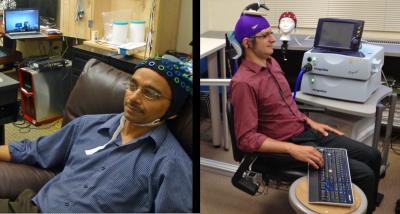
Using electrical brain recordings and a form of magnetic stimulation, Rajesh Rao sent a brain signal to Andrea Stocco on the other side of the UW campus, causing Stocco's finger to move on a keyboard.While researchers at Duke University have demonstrated brain-to-brain communication between two rats, and Harvard researchers have demonstrated it between a human and a rat, Rao and Stocco believe this is the first demonstration of human-to-human brain interfacing.

"The Internet was a way to connect computers, and now it can be a way to connect brains," Stocco said. "We want to take the knowledge of a brain and transmit it directly from brain to brain."

The researchers captured the full demonstration on video recorded in both labs. The version available at the end of this story has been edited for length. Rao, a UW professor of computer science and engineering, has been working on brain-computer interfacing (BCI) in his lab for more than 10 years and just published a textbook on the subject. In 2011, spurred by the rapid advances in BCI technology, he believed he could demonstrate the concept of human brain-to-brain interfacing. So he partnered with Stocco, a UW research assistant professor in psychology at the UW's Institute for Learning & Brain Sciences.

On Aug. 12, Rao sat in his lab wearing a cap with electrodes hooked up to an electroencephalography machine, which reads electrical activity in the brain. Stocco was in his lab across campus wearing a purple swim cap marked with the stimulation site for the transcranial magnetic stimulation coil that was placed directly over his left motor cortex, which controls hand movement.The team had a Skype connection set up so the two labs could coordinate, though neither Rao nor Stocco could see the Skype screens.Rao looked at a computer screen and played a simple video game with his mind. When he was supposed to fire a cannon at a target, he imagined moving his right hand (being careful not to actually move his hand), causing a cursor to hit the "fire" button. Almost instantaneously, Stocco, who wore noise-canceling earbuds and wasn't looking at a computer screen, involuntarily moved his right index finger to push the space bar on the keyboard in front of him, as if firing the cannon. Stocco compared the feeling of his hand moving involuntarily to that of a nervous tic.


"It was both exciting and eerie to watch an imagined action from my brain get translated into actual action by another brain," Rao said. "This was basically a one-way flow of information from my brain to his. The next step is having a more equitable two-way conversation directly between the two brains."

The technologies used by the researchers for recording and stimulating the brain are both well-known. Electroencephalography, or EEG, is routinely used by clinicians and researchers to record brain activity noninvasively from the scalp. Transcranial magnetic stimulation, or TMS, is a noninvasive way of delivering stimulation to the brain to elicit a response. Its effect depends on where the coil is placed; in this case, it was placed directly over the brain region that controls a person's right hand. By activating these neurons, the stimulation convinced the brain that it needed to move the right hand.Computer science and engineering undergraduates Matthew Bryan, Bryan Djunaedi, Joseph Wu and Alex Dadgar, along with bioengineering graduate student Dev Sarma, wrote the computer code for the project, translating Rao's brain signals into a command for Stocco's brain.

"Brain-computer interface is something people have been talking about for a long, long time," said Chantel Prat, assistant professor in psychology at the UW's Institute for Learning & Brain Sciences, and Stocco's wife and research partner who helped conduct the experiment. "We plugged a brain into the most complex computer anyone has ever studied, and that is another brain."At first blush, this breakthrough brings to mind all kinds of science fiction scenarios. Stocco jokingly referred to it as a "Vulcan mind meld." But Rao cautioned this technology only reads certain kinds of simple brain signals, not a person's thoughts. And it doesn't give anyone the ability to control your actions against your will.


Both researchers were in the lab wearing highly specialized equipment and under ideal conditions. They also had to obtain and follow a stringent set of international human-subject testing rules to conduct the demonstration.

"I think some people will be unnerved by this because they will overestimate the technology," Prat said. "There's no possible way the technology that we have could be used on a person unknowingly or without their willing participation."

Stocco said years from now the technology could be used, for example, by someone on the ground to help a flight attendant or passenger land an airplane if the pilot becomes incapacitated. Or a person with disabilities could communicate his or her wish, say, for food or water. The brain signals from one person to another would work even if they didn't speak the same language.Rao and Stocco next plan to conduct an experiment that would transmit more complex information from one brain to the other. If that works, they then will conduct the experiment on a larger pool of subjects.
Scientists now have made the first-ever accurate determination of a solid-state triple point in a substance called vanadium dioxide, which is known for switching rapidly -- in as little as one 10-trillionth of a second -- from an electrical insulator to a conductor, and thus could be useful in various technologies.

"These solid-state triple points are fiendishly difficult to study, essentially because the different shapes of the solid phases makes it hard for them to match up happily at their interfaces," said David Cobden, a University of Washington physics professor."There are, in theory, many triple points hidden inside a solid, but they are very rarely probed.".In 1959, researchers at Bell Laboratories discovered vanadium dioxide's ability to rearrange electrons and shift from an insulator to a conductor, called a metal-insulator transition. Twenty years later it was discovered that there are two slightly different insulating phases.

The new research shows that those two insulating phases and the conducting phase in solid vanadium dioxide can coexist stably at 65 degrees Celsius, give or take a tenth of a degree (65 degrees C is equal to 149 degrees Fahrenheit).To find that triple point, Cobden's team stretched vanadium dioxide nanowires under a microscope. The team had to build an apparatus to stretch the tiny wires without breaking them, and it was the stretching that allowed the observation of the triple point, Cobden said.

It turned out that when the material manifested its triple point, no force was being applied -- the wires were not being stretched or compressed.The researchers originally set out simply to learn more about the phase transition and only gradually realized that the triple point was key to it, Cobden said. That process took several years, and then it took a couple more to design an experiment to pin down the triple point."No previous experiment was able to investigate the properties around the triple point," he said.

He regards the work as "just a step, but a significant step" in understanding the metal-insulator transition in vanadium dioxide. That could lead to development of new types of electrical and optical switches, Cobden said, and similar experiments could lead to breakthroughs with other materials."If you don't know the triple point, you don't know the basic facts about this phase transition," he said. "You will never be able to make use of the transition unless you understand it better."
The discovery alters understanding of the chemistry that moves manganese and other elements, like oxygen and carbon, through the natural world. Manganese is an essential nutrient for most organisms and helps plants produce oxygen during photosynthesis.

"You wouldn't think manganese is that important, but without manganese, we wouldn't have the molecular oxygen that we breathe," said study co-author George Luther, Maxwell P. and Mildred H. Harrington Professor of Oceanography in the School of Marine Science and Policy within UD's College of Earth, Ocean, and Environment.

Manganese is present in the environment in three forms -- manganese(II), manganese(III) and manganese(IV) -- the difference related to the oxidation state, or number of electrons present. When elements lose or gain an electron, the oxidation state changes in a "redox reaction," like when iron turns into rust by losing electrons to oxygen in air.

The second-most common metal in Earth's crust, manganese rapidly changes between oxidation states while reacting with other elements in the environment.Traditionally, manganese(II) and manganese(IV) were believed to be the dominant forms in aquatic environments. But in the mid-2000s, Luther found in a surprising result that manganese(III) was also present in a Black Sea "transition zone," an area where oxygen levels are relatively high near the surface but gradually diminish deeper down in the water.

Suspecting that this intermediary form was far more widespread than the somewhat unique conditions of the Black Sea, he and his Canadian colleagues Bjørn Sundby of the University of Quebec at Rimouski and Al Mucci of McGill University, whom he has worked with more than 20 years, set out for the largest estuary in the world: the Gulf of Saint Lawrence off the southeast corner of Canada.There they pulled up samples of mud from the seafloor, where in the top few inches of sediment, there is also a transition zone of diminishing oxygen amounts. Andrew Madison, lead author on the Science paper and Luther's former graduate student, used a new technique to differentiate between manganese forms.

"It was a bit frustrating, and I spent about two and a half years working through methodological challenges and complications," said Madison, who finished his doctorate last year and now works as geochemist at Golder Associates Inc. in New Jersey. "But it was also pretty rewarding when I finally got something to work."

His results showed that manganese(III) comprised up to 90 percent of the total manganese present in the Canadian study sites. The implication is that the metal is found in other marine environments where there is a gradation of oxygen concentrations, whether in the water column of the Black Sea, sediment in the Gulf of Lawrence or a Delaware salt marsh."We saw it all through the Saint Laurentian Estuary where we studied," Luther said. "We did some work in a local salt marsh and found it. Wherever we've been able to look for it, we've found it. By implication, it should be found in all ocean sediments."

The findings help explain anomalies in manganese models that have puzzled scientists. Other researchers studying manganese did not make specific measurements for manganese(II) versus manganese(III), Luther said. Rather, they measured total dissolved manganese and assumed it was the former.This missing link in the manganese cycle may shed light on the complex connections between the biology, geology and chemistry -- called biogeochemistry -- in ocean environments.The biogeochemistry of marine sediments revolves around organic matter, like bits of dead algae, that fall through the water to the bottom of the ocean. Bacteria consume that debris, setting off a chain of reactions.

"In sediments, bacteria prefer to consume molecular oxygen and nitrate first due to their high energy gain," Madison said. "After those are consumed, bacteria then couple organic matter oxidation to manganese oxide reduction, which can produce soluble manganese(III)."In their paper, the researchers call for the conceptual model of the sedimentary redox cycle to be revised to include dissolved manganese(III).

"Manganese is helpful to produce organic matter in the surface waters through photosynthesis," Luther said. "But in the sediments, the higher oxidation state manganese is used to decompose organic matter. So it's a really interesting cycle."Luther, his students and his Oregon Health & Science University collaborator, Brad Tebo, plan to return to Canada to continue work on the microbiology and chemistry of the processes, hopefully to find out which organisms are helping the manganese oxidation process.
Since the 1960s, it has been known that groundwater resources in certain provinces of China are contaminated with arsenic. Estimates of the numbers of affected people have risen year by year. In the most recent survey -- conducted by the Chinese Ministry of Health between 2001 and 2005 -- more than 20,000 (5%) of the 445,000 wells tested showed arsenic concentrations higher than 50 µg/L. According to official estimates, almost 6 million people consume drinking water with an arsenic content of more than 50 µg/L and almost 15 million are exposed to concentrations exceeding 10 µg/L (the guideline value recommended by the WHO).

Given the sheer size of China and the time and expense involved in testing for arsenic contamination, several more decades would probably be required to screen all of the millions of groundwater wells. Accordingly, a group of researchers from Eawag and the China Medical University in Shenyang developed a statistical risk model making use of existing data on geology, soil characteristics and topographic features. This model was calibrated using available arsenic measurements. The predictions of unsafe or safe areas showed a high level of agreement, both for known high-risk areas and for areas where elevated arsenic levels had been ruled out by sampling campaigns.

In addition, large areas have now been identified as potentially at risk, such as the basins of the Tarim (Xinjiang), Ejina (Inner Mongolia) and Heihe (Gansu), or the North China Plain (Henan and Shandong). Arsenic concentrations above 10 µg/L are predicted for a total area of 580,000 km2. When these results were combined with the latest available population data, it was found that almost 20 million people across China live in high-risk areas.

Geochemist Annette Johnson concedes: "This figure may be an overestimate, as we lack reliable information on the number of people with treated water sup-plies." But in the long term, she adds, China will remain dependent on groundwater as a source of drinking water, particularly in the arid provinces. The risk model shows where conventional groundwater quality monitoring efforts are best focussed: "Our method permits more targeted sampling cam-paigns and saves time in identifying populations at risk. The Chinese authorities are adopting our maps in the national monitoring programme." Johnson is convinced that the model could also be used in other countries where groundwater is known or suspected to be contaminated with arsenic -- for example, in Africa or in central Asia, where risk assessments for arsenic contamination have not yet been performed.

Arsenic background

Arsenic is one of the most common inorganic contaminants found in drinking water worldwide. This metalloid occurs as a natural component of sediments, with small quantities being dissolved in groundwater as a result of weathering. The inorganic salts of arsenic are tasteless and odourless, but highly toxic to humans. If ingested over long periods, even low concentrations can cause damage to health, including hyperpigmentation of the skin, hyperkeratosis on the palms and soles, disorders of liver, cardiovascular and kidney function, and various types of cancer.

Problems arise from the fact that firstly, arsenic concentrations can vary widely at the local level and, secondly, people in many areas are completely unaware of the risk because their groundwater wells have never been screened for arsenic. Concentrations below 10 µg/L are considered safe. This concentration is therefore recommended by the World Health Organi-zation as a guideline value for arsenic in drinking water. In China, the standard guideline has just recently changed from 50 µg/L to 10 µg/L. In many other studies, e.g. at various sites in Inner Mongolia, arsenic concentrations of more than 100 µg/L and up to 1500 µg/L have been measured.